
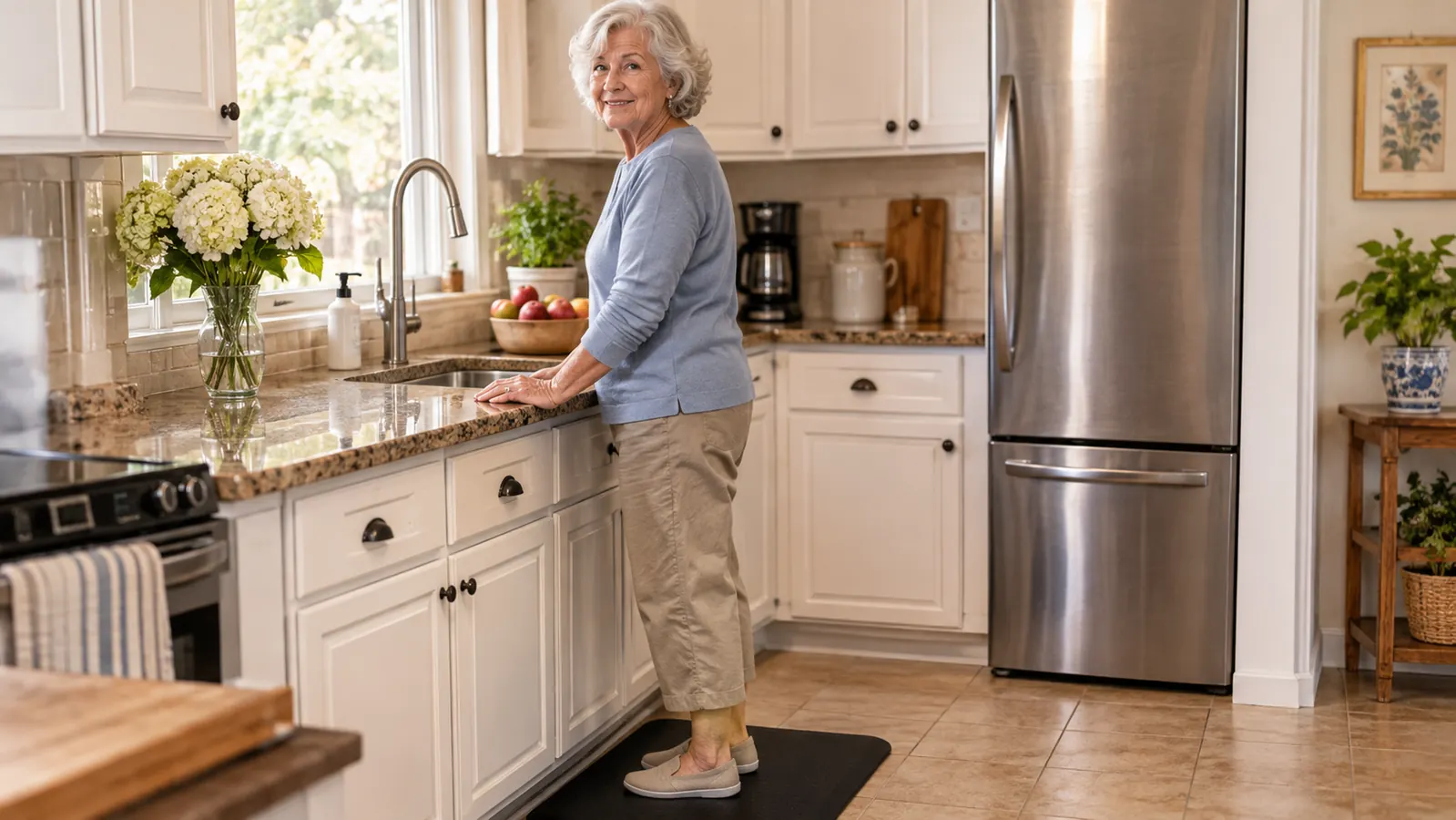
Sunday dinner used to end with me sitting down before the dishes were done. Not because I wanted to. Because my right knee had gone hot and tight, and standing at the sink to rinse a roasting pan had turned into something I had to talk myself through. I am 68, I live alone in Lakeland, and I cooked in a school cafeteria for 29 years, so I know exactly what standing on hard tile does to a person.
That kitchen had quarry tile and nothing soft at my station. I stood on it for hours a day for nearly three decades and never thought twice about it. When I retired five years ago, my doctor diagnosed osteoarthritis in my right knee and at the base of both thumbs, and the tile in my own house started feeling different under me. Last January I bought a ComfiLife anti fatigue mat, the 20 by 32 inch one, three quarters of an inch thick. It was the first thing I bought for any of this. Before the knee wrap, before the capsules, before the jar opener, before the cane. It is the one that helped first, and it is the one I would replace first if it ever wore out.
The Quick Verdict
The rare purchase that changed my Sunday before I noticed it changed. It will not fix your knee. It will make two hours at the counter feel like two hours instead of four.
Amazon Check Today's Price →Two hours at the stove, and my knee stopped being the reason I quit early
20 by 32 inches, three quarters of an inch of high-density memory foam, non-slip bottom, wipes clean with a damp cloth. 4.8 stars across more than 42,000 reviews. Mine has been on the same tile for 22 months.
Amazon Check Today's Price on Amazon →How I've Used It
The mat sits on the tile between my stove and my sink, which is the exact spot where I do everything. Chopping, stirring, carrying a pot to the sink, turning back to the stove. That turn is what my knee hates most, and that is where I put the mat. It has not moved in 22 months. I own one mat. Not one in front of the sink and one in front of the stove. One, in the gap, where the work happens.
Before the mat there was a thin cotton rag rug in that spot. It was there because my mother had one, not because it did anything for anybody. It bunched up under my feet and I was always kicking it back into place with my toe, usually with something hot in my hands. The day the mat arrived I carried the rag rug out to the laundry room and it has not come back. That is the whole installation story. I put it down and it stayed down.
Before I ordered it I measured the gap with the yardstick from the junk drawer. Twenty inches deep, thirty four wide, with the dishwasher door swinging through the corner. Then I laid a bath towel down on the tile and stood on it for a few minutes to see whether I would feel crowded. A towel is nothing like a mat, but it told me the size would work, and it kept me from guessing. If you are doing this, measure the gap, not the kitchen. My kitchen is not a big room and the space I actually stand in is smaller than the room.
The first week is what I remember. Not a dramatic change, just an absence. After Sunday dinner I noticed my feet did not feel pounded, and my lower back was not doing that dull complaining thing it does after two hours standing. Paula's husband had carried the roasting pan to the counter for me the week before. That Sunday I carried it myself, and it did not occur to me until later that I had.
Paula noticed before I did. She came in the back door one Sunday, set the pie down, and said I was still standing. She meant it as a joke about how I used to sit down halfway through the potatoes. I had not thought about it at all. That is the kind of change this is. Nobody hands you a certificate for standing through your own dinner.
There were no mats at my station in that school kitchen, just quarry tile, and I stood on it for hours a day for 29 years. I am not going to tell you a mat would have saved me anything back then. I am telling you that when I finally stood on one at home, I noticed what I had been putting up with, and I noticed it in the first week.
I wipe it with a damp cloth. That is the entire maintenance routine, and it matches the care instructions that came with it. Nothing has had to be scrubbed out of it. What it does do is show everything. A dusting of flour, a crumb of cornbread, a splash of grease off a skillet. I keep a cloth in the drawer beside the sink and I give the mat a wipe before I start cooking and again when I finish, which takes about as long as it took you to read this paragraph.
What Three Quarters of an Inch Feels Like Underfoot
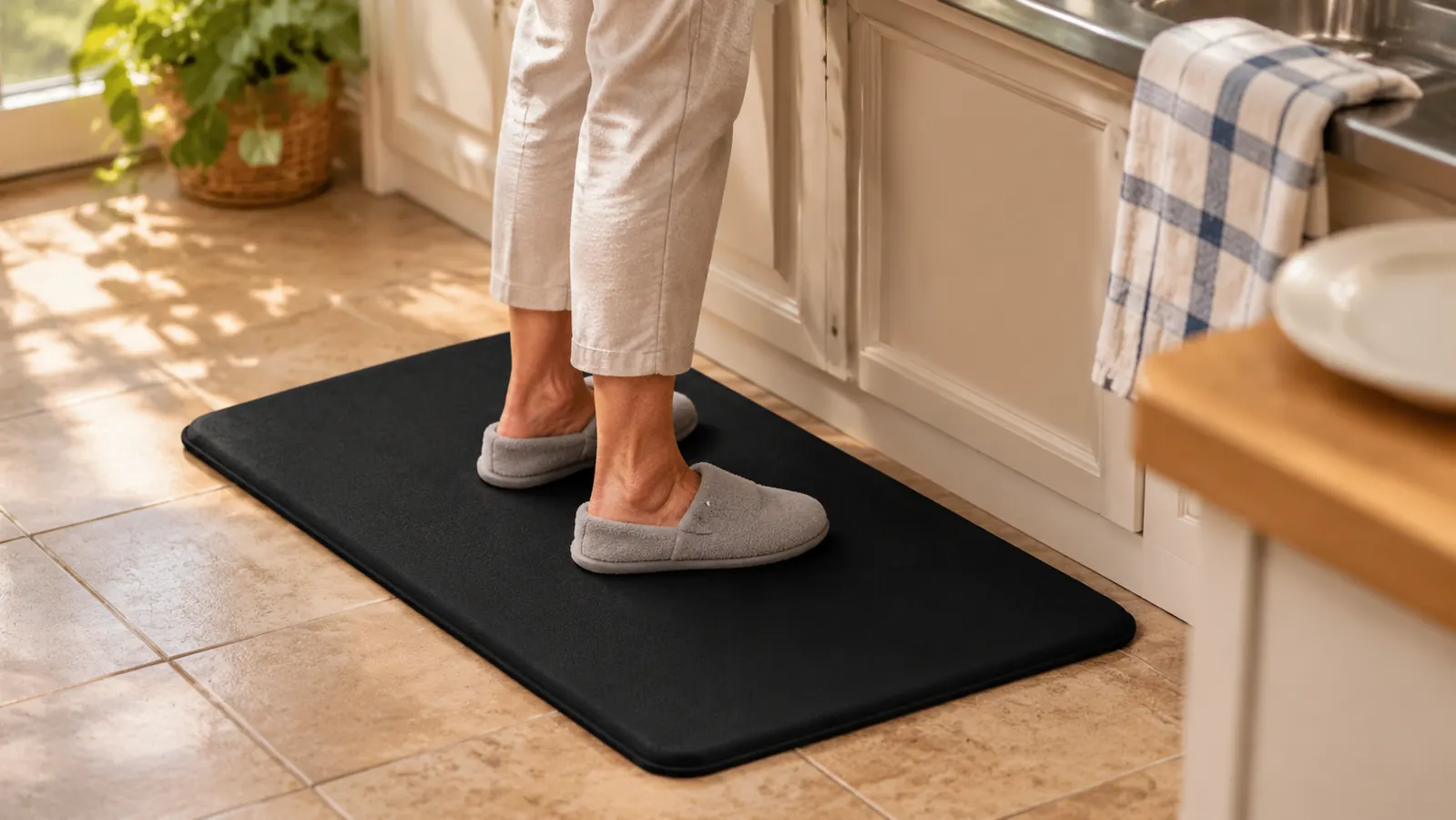
The core of the ComfiLife mat is high density memory foam, three quarters of an inch thick, and the difference you feel is that you stop bracing. On bare tile your legs make a constant small correction, a stiffening through the knee and the hip that you are not aware of until it stops. The mat gives under your weight and then holds. It does not swallow your foot and it does not put you back on the tile underneath.
I am 5 foot 4 and I wear soft-soled slip-ons around the house most of the day. In the shoes the mat feels like standing on a firm cushion. Barefoot it feels better, honestly, because the give comes through the whole foot instead of through a sole. My right knee is the bad one, and it is the one that votes. Two hours on the mat and it is tired at the end of the evening. Two hours on the tile and it is tired and hot and I am done before the dishes.
In February of last year I timed it, because I wanted to know whether I was imagining things. Same recipe, same pot of sauce, same batch of rolls, a Sunday when Paula and her husband were coming at five. On the tile, from the year before, I had been sitting down at the forty minute mark. On the mat I finished the pan and wiped the counter before I sat. I am not a scientist and one Sunday is not a study. But I know what my own knee was telling me, and it told me the same thing twice.
The size matters more than I expected. Twenty by 32 inches is enough for me to stand with both feet on it and shift side to side as I work, and narrow enough that it does not take over the floor. My kitchen is small. A wider mat would have been in the way of the dishwasher door. This one sits in the gap, the door opens over the corner of it, and nobody trips.
Two hours on the tile and I was sitting down before the dishes were done. Two hours on the mat and I carried the roasting pan to the counter myself.
The Bottom, the Edges, and the Flour Problem
The bottom has a grip to it. My floor is tile with a sheen on it from years of mopping, and the mat does not slide when I step onto it, even in socks. I tested that on purpose the first week, because a sliding mat in a kitchen is how a person ends up on the floor, and I have never fallen and I do not intend to start at 68.
I mopped on Saturdays for years before all of this and I still do. The mat lifts up, I set it against the wall while the floor dries, and it goes back down before I start the Sunday cooking. That is the only time it is ever off the tile in a week. The grip has not gone slick in 22 months, and I have looked, because a mat that starts sliding after a year is a mat you throw out.
The edges have stayed flat. Twenty two months of daily cooking and a Sunday dinner every week, and no corner has curled up to catch my toe. That was my one real worry when I bought it. Rag rugs curl. Thin mats curl. This one has a squared edge that sits down on the tile and stays down, and I have not had to straighten it once.
Cleaning is a damp cloth, and that is all I have ever done to it. The surface is stain resistant and moisture resistant, which matters in Florida, where the air in August is basically a wet towel. I have not had a mildew problem with it, and it does not hold a smell from cooking. The only nuisance is that it shows every crumb, so it gets a wipe most days. That is a small thing to trade for standing through the potatoes.
Where It Stops Helping
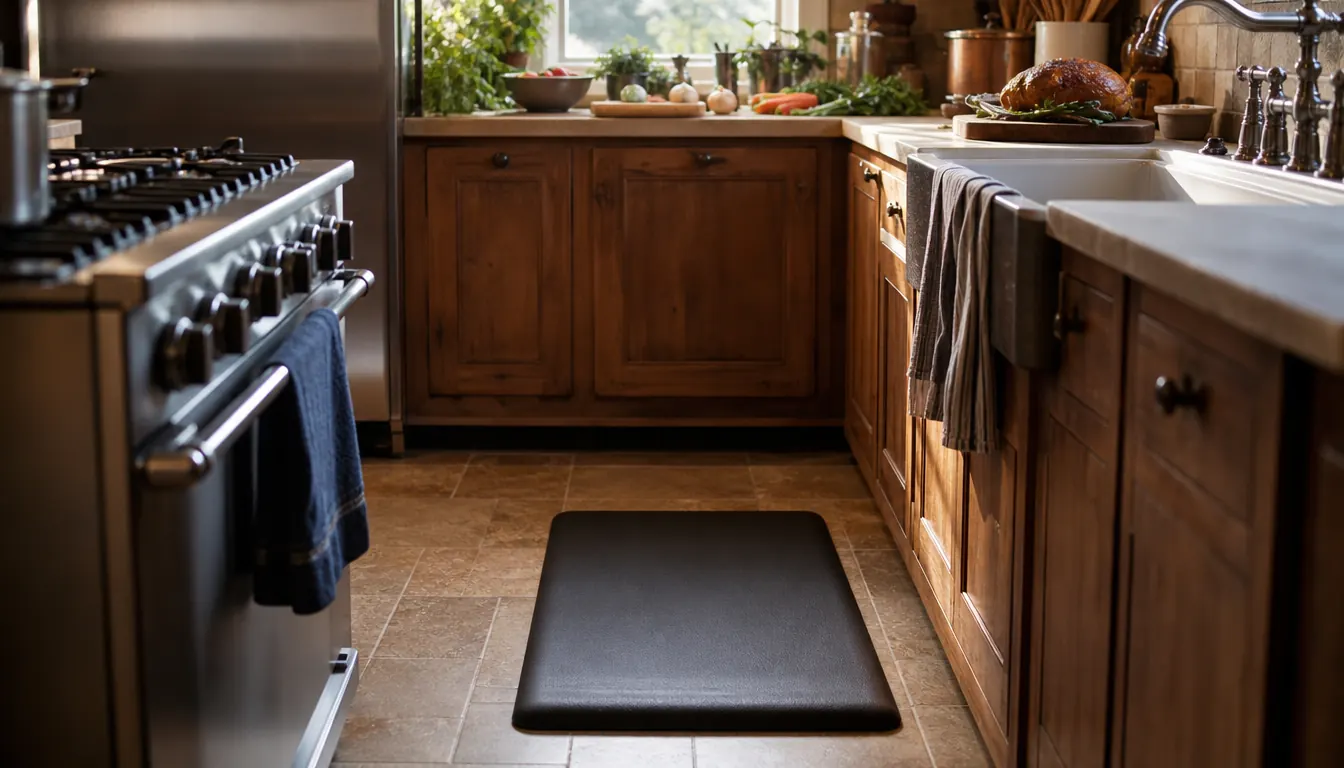
It does nothing for a jar lid. It does nothing for the walk from the grocery store out to the car. It does nothing for my thumbs. If you are hoping one purchase will fix everything that has gotten harder in the last few years, this is not that, and no floor mat is. It helps one thing, in one spot, and it helps that thing a lot.
I know where the line is because I crossed it once. I carried the mat out to the garage, thinking I would use it at the workbench while I sorted through some tools, and I brought it back inside within the hour. It was the wrong room and the wrong job and I felt a little foolish for trying. It lives in the gap between the stove and the sink and that is settled.
It also does not treat anything. I still have arthritis in my right knee. My doctor diagnosed it about five years ago and it has not gone anywhere since. The mat changes how two hours at the counter feels. It does not change a diagnosis, and if you are looking for something that does, you should be talking to your doctor, not shopping for a floor mat. Same advice I would give about the capsules I take, and I asked her before I started those too.
One more thing worth saying plainly. A mat under your feet does not make you steadier on your feet. If balance is the problem, that is a different conversation and a more important one, and it belongs with your doctor rather than with a product listing.
And it stays in one spot. Mine has not moved since the day I set it down and I like it that way. If you are picturing carrying it out to the garage when you are at the workbench and back to the kitchen afterward, that is a second mat, not this one.
What I Liked
- Three quarters of an inch of high density memory foam gives underfoot without dumping you back onto the tile
- The non-slip bottom held on a slick tile floor, tested deliberately in socks
- No corner has curled in 22 months of daily cooking and weekly Sunday dinners
- Wipes clean with a damp cloth, nothing has needed scrubbing
- 20 by 32 inches fits the gap between a stove and a sink in a genuinely small kitchen
Where It Falls Short
- It shows every crumb and smear, so it needs a wipe most days
- Does nothing for hands, jars, or walking from the car
- One spot only, it is not something you move around the house
- It is a floor mat, not a treatment. The arthritis is still there
Who This Is For
If you are the one who cooks, and you have started sitting down halfway through, this is worth doing before you buy anything more complicated. It was the first of five things I bought and it is the one I would buy again tomorrow. It suits anyone who stands in one place for a long stretch. The cook, the baker, the person who does the dishes, the person at a workbench in the garage, the person at a standing desk. All of those are places the ComfiLife mat is built for, and all of them are places where hard floor is doing you no favors.
It is also an easy thing to hand to a parent who insists the kitchen is fine. It does not look medical. It does not need explaining. It does not need to be plugged in or fitted or adjusted, and it goes down on the floor in about thirty seconds. My daughter would tell you that matters, because I have turned down plenty of things that required a conversation first.
Who Should Skip It
Skip it if the problem is not standing. If your knees hurt when you get up out of a chair, a mat under the counter will not touch that. If your hands are the trouble, a jar is not going to open any easier because your feet are comfortable. I bought four other things for those problems and none of them was a mat.
Skip it if your kitchen is so tight that 20 by 32 inches would block a drawer or a walkway. Measure the gap first. Mine fits because I measured the space between the stove and the sink before I ordered, and if I had guessed I would have been wrong by two inches. And skip it if what you want is something to take to the garden or the ball field. This is a floor mat that lives where you put it.
Before you buy anything else for your knees, start with the floor
Twenty two months, one small kitchen, one mat that has not curled or slid. If you stand in one spot to cook, this is the simplest change you can make and the one you will notice in the first week.
Amazon Check Today's Price on Amazon →