
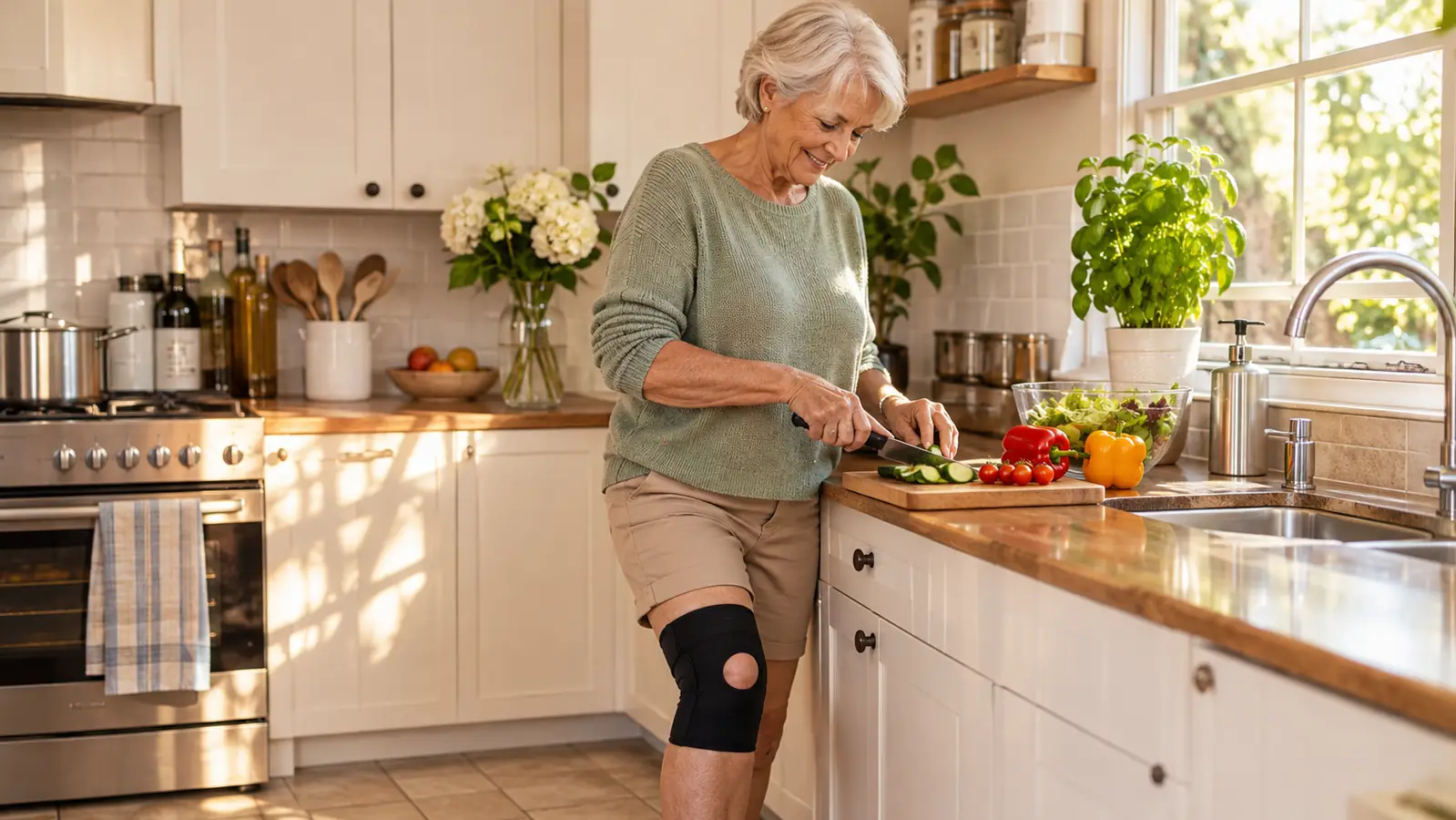
The first time I strapped a knee brace on, I got it wrong. I had it sitting too low on my leg and too loose along the bottom edge, and by the time the potatoes went on I had a wad of fabric bunched behind my knee and a worse mood than when I started. My name is Rosalind Mayfield. I am 68, I live in Lakeland, and I spent 29 years running the kitchen at a public elementary school before I retired. I have arthritis in my right knee, and every Sunday I still cook dinner for my daughter Paula and her husband. That is two to three hours on a tile floor between the stove and the sink, and it is the standing, not the cooking, that my knee minds.
What I have learned in the year since is that fitting a brace is not one decision. It is five small ones. Get any one of them wrong and the thing slides down your leg, or pinches behind the knee, or runs so hot you peel it off halfway through the beans. I wear the Bracoo knee support, the KS10, an adjustable wrap with an opening for the kneecap, and once I started doing these five things in this order it stopped fighting me. Here they are.
The fit does most of the work. Start with the right brace.
The Bracoo KS10 is the adjustable wrap I wear on my right knee for Sunday cooking and long errands: a hook-and-loop closure, an open kneecap area, and a reinforced ring around that opening. It runs hot in a Florida kitchen, and I will say so every time.
Amazon See Today's Price on Amazon →Step 1: Start with a bare knee, not over your trousers
The single biggest reason a wrap slides down is fabric under it. My first month I wore the Bracoo over a pair of wide-leg cotton trousers because I was in a hurry, and it crawled down my leg every time I turned around. Neoprene grips skin. It does not grip a loose hem.
Bare skin is what this brace was made for, and it is how I wear it now, with the opening centered and the closure sitting flat. The one exception is a very thin legging, the kind that is tighter than skin, which some people prefer for the feel of it. Thick sweatpants, a skirt hem, or anything that bunches is going to bunch more once you add a wrap on top of it.
I learned that the hard way in March of last year. I had a pair of drawstring trousers on, the kind I wear to the grocery store, and I put the brace on over them because Paula was already at the door. Ten minutes into the cooking the bottom edge had rolled itself into a rope behind my knee, and I stood at the stove trying to flatten it with one hand while the other one held a spoon. I finished the meal, but I was out of sorts through all of it, and the knee was no better off than if I had left the brace in the drawer. Now I change into what I am cooking in first and put the brace on last, and I have not had a repeat.
If your skin is sensitive, or you are the sort of person who reacts to elastic, do not skip this part. The label on this brace says plainly that it contains neoprene and that you should stop wearing it and see a doctor if a rash develops. I have not had one, but I know two women who did. Start with a short wear the first week and look at your skin afterward.
Step 2: Line the opening up on your kneecap before you fasten anything
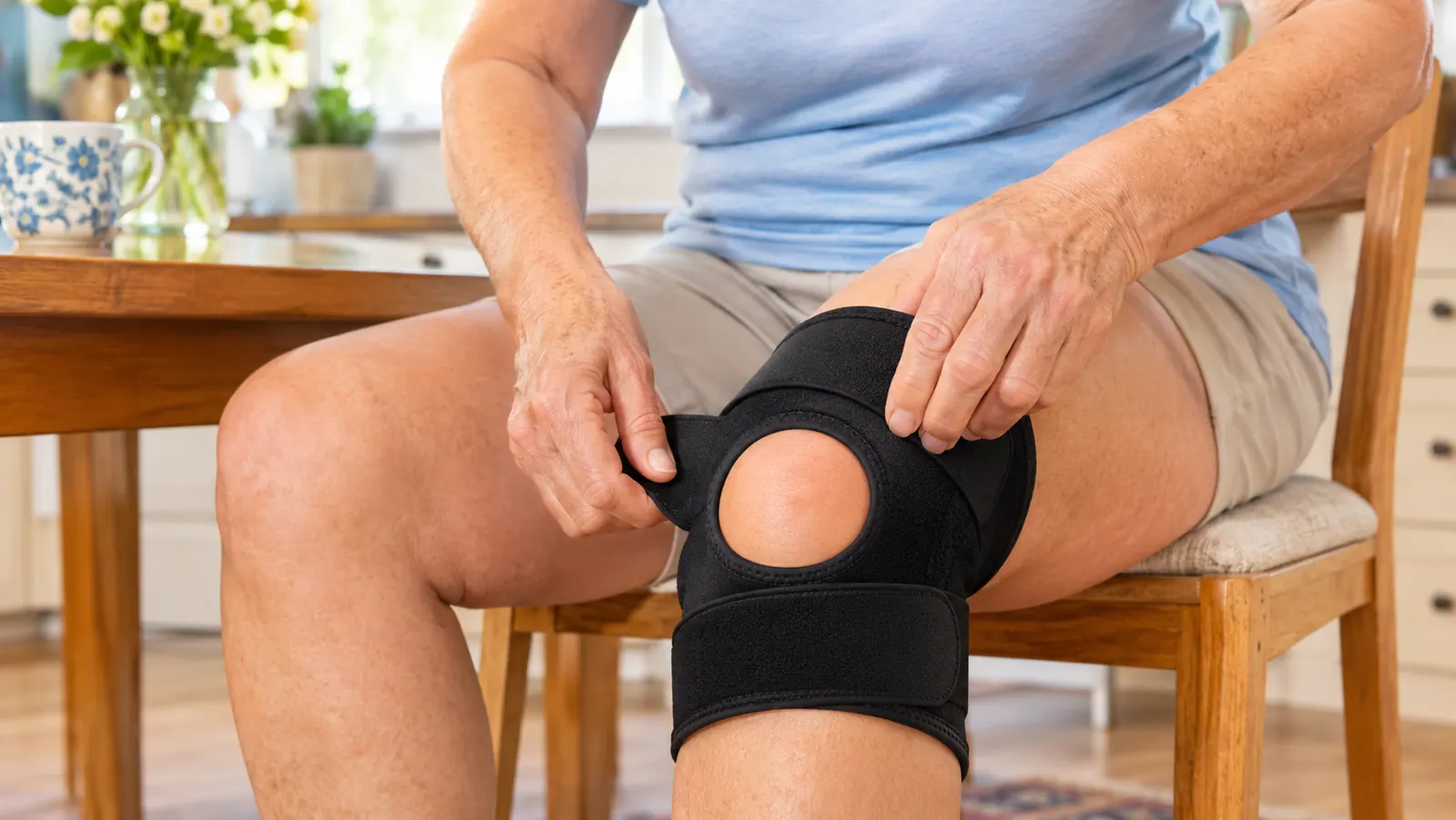
Set the brace in place with the closure still loose, then look down. The opening should sit right over your kneecap, not above it and not below it. This sounds obvious and it is the step I skipped for two weeks. If the opening rides high, the whole brace pulls upward when you bend, and you spend the afternoon hitching it back down like a pair of bad pants.
The KS10 has a reinforced ring around that opening. The point of it is to hold the kneecap steady while you bend and straighten. It only does that if the ring is centered on the kneecap to begin with, which means checking it in a mirror or by feel every single time you put it on, not just the first time.
I do it standing at the counter with my right foot up on the bottom shelf of the island. Leg straight, opening centered, thumb on the ring to hold it while I reach for the closure. It takes about four seconds now. It took a week to become a habit.
The brace did not take my arthritis away. What it did was make the turn between the stove and the sink feel like a turn I could trust.
Step 3: Fasten from the bottom up, snug and not tight
Fasten the lower part of the closure first, then the upper part, tightening each a little at a time rather than cranking one down all the way. If you tighten the top first, the brace pushes the kneecap down and the whole thing works loose by the time you are basting.
Snug means the brace stays put when you take three steps. Tight means you can see the edge of the fabric pressing a line into your skin. You want snug. A brace does not need to cut off circulation to help, and if your calf starts to feel cold or your foot goes numb, that is your signal to loosen it, not to push through until the timer goes off.
I check mine once about halfway through the cooking, right after the roast goes in. By then I have bent and reached enough to know whether the fit held. If it has slid, I take thirty seconds to reset it rather than living with it. Thirty seconds is nothing compared with two hours of a brace that is riding wrong.
I know what a slip looks like on me now. The top edge of the wrap ends up about an inch lower than where I set it, and the ring is sitting under the kneecap instead of over it. When that happens I do not simply pull the top strap tighter, because that is exactly what got me into trouble that first month. I unfasten both sections, set the ring back on the kneecap, and start over from the bottom. It takes half a minute, and it saves the rest of the afternoon.
Step 4: Try it for twenty minutes before you trust it with a Sunday
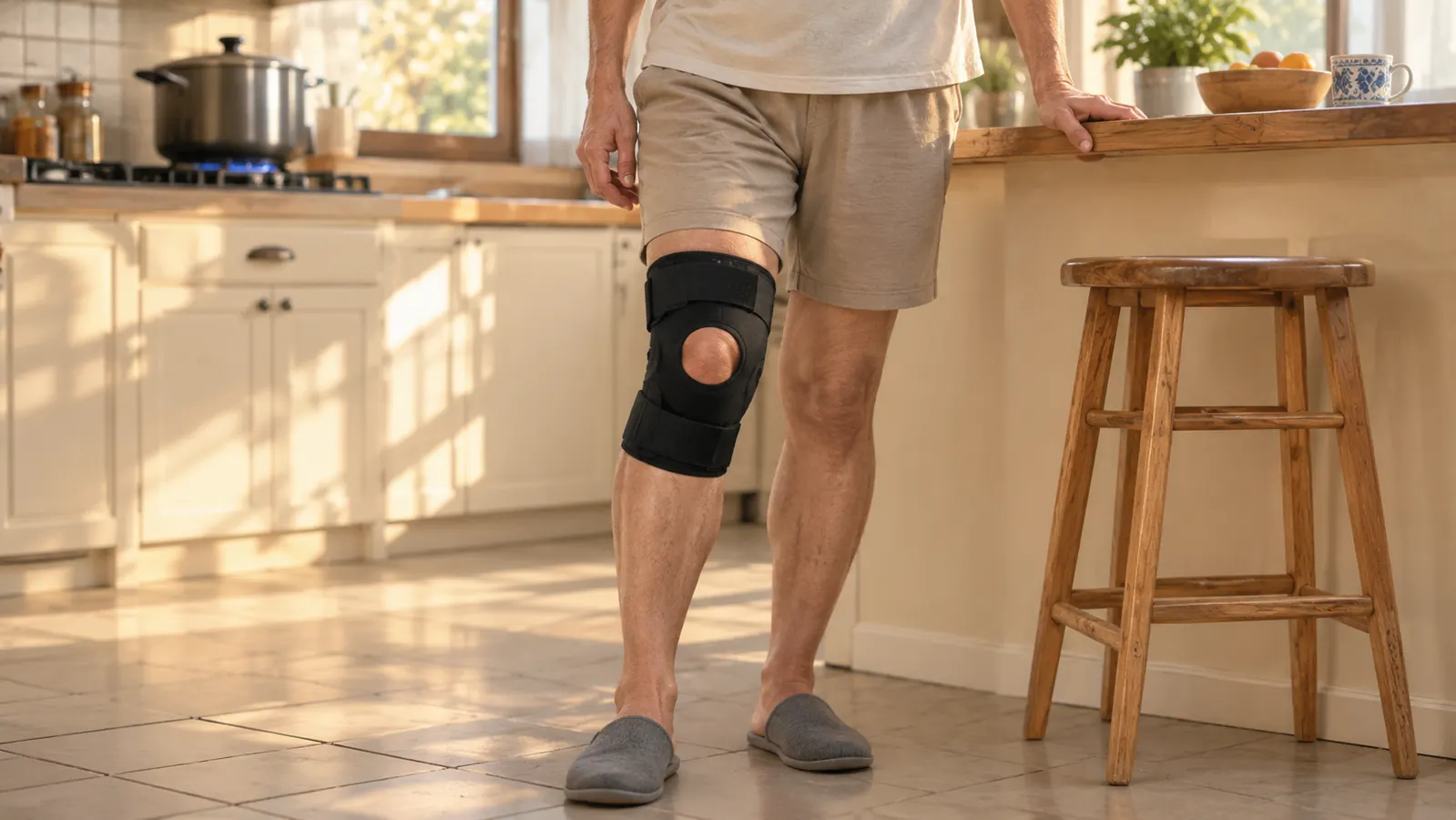
Do not put a new brace on for the first time at the start of a three-hour cooking session. Wear it around the house for twenty minutes on a normal afternoon. Make a cup of tea, carry some laundry, walk out to the mailbox and back. You are checking three things: does it slide, does it pinch behind the knee, and does it get too hot.
In my case those twenty minutes told me two things. The first was that the brace was going to work, because my knee felt steadier on the turn from the counter to the table than it had in months. The second was that my fit was wrong in a way I could not feel while standing still. It only showed up once I walked, and it showed up as a slow creep down the front of my shin. Twenty minutes around my own living room found that. Three hours of cooking would have found it too, at a much worse moment.
Heat is the honest complaint about this brace. Neoprene holds warmth, which is part of why it feels good on a stiff knee, and it is also why a Florida kitchen in July is not its friend. I wear mine for two to four hours at a stretch, which covers a Sunday dinner and the clean-up afterward. It comes off when I sit down for the evening, and I have never once slept in it. The instructions do not suggest it and neither would I.
If you find it too warm, the fix is usually timing, not a different brace. Put it on right when you start the chopping and take it off when the last plate is in the drying rack. That is what I do, and it has kept me in the thing for a year.
Step 5: Take it off at the end of the day and wash it by hand
Hook-and-loop closures collect lint, and neoprene collects the smell of a kitchen. Mine gets a hand wash in the sink with a little mild soap every couple of weeks, then I press it between two towels and let it air dry flat. I have never put it in the machine, and I would not. Heat and tumbling are hard on the material, and the closure will grab everything in the load.
Before you wash it, close the hook-and-loop so it does not snag the fabric or your other laundry. Lay it flat rather than draping it over a chair back, so it does not dry into a shape it will keep. The Bracoo has held its shape for about a year of this, and it still centers on the kneecap on the first try.
What Else Helps
A brace is one piece. The other things in my kitchen have done as much or more, and I would be doing you a disservice to leave them out.
The first thing that helped was a mat, not a brace. I bought a ComfiLife mat, 20 by 32 inches and three-quarter inch thick, and put it in front of the counter between the stove and the sink. It does not move, and it is the reason my feet and lower back stopped feeling beat up after Sunday dinner. I stood on bare quarry tile for 29 years at that school and never thought about it once. Now I think about it every Sunday. The mat does nothing for jar lids or for walking, and I am not going to pretend otherwise.
My cane comes out for the grocery store and the walk around the lake, not for my own kitchen. I hold it in my left hand, opposite the bad knee. I resisted it for about a year because I felt too young for one, and Paula was right and I was wrong. What changed my mind was not a fall, because I have never fallen. It was a long grocery trip that left my knee aching on the walk out to the car, and I bought the cane myself the following week. It took about two weeks before it felt natural. The folding base stays up on its own, which matters more than I expected at the checkout while I am digging for my wallet.
The electric jar opener is the small thing that saves my thumbs, which have their own arthritis at the base. It sits flat on the lid, I press the button, and it does the turning. It has not opened a can in its life and it will not fit the gallon pickle jars I used to wrestle by hand at the school. It is my own kitchen and my own two thumbs I am talking about. And the capsules I take are a conversation to have with your own doctor before you start, not something a neighbor should prescribe. Mine said yes. Yours may say something different, and that is fine.
One last thing, and I mean it plainly. A brace is a support, not a treatment. It does not rebuild anything and it does not stop arthritis. Mine makes my knee feel steadier on the turn between the stove and the sink, and that is the whole claim. If your knee is swollen, hot, locking, or giving way, that is a doctor conversation, not a strap adjustment. I asked mine before I started wearing anything, and I would ask again.
Fit it once, then cook the whole afternoon.
The Bracoo KS10 wrap is the one I wear on my right knee for two to four hours at a stretch. Snug, centered on the kneecap, and off before I sit down. If it runs hot in your kitchen, you are not doing it wrong.
Amazon See the Bracoo KS10 on Amazon →