
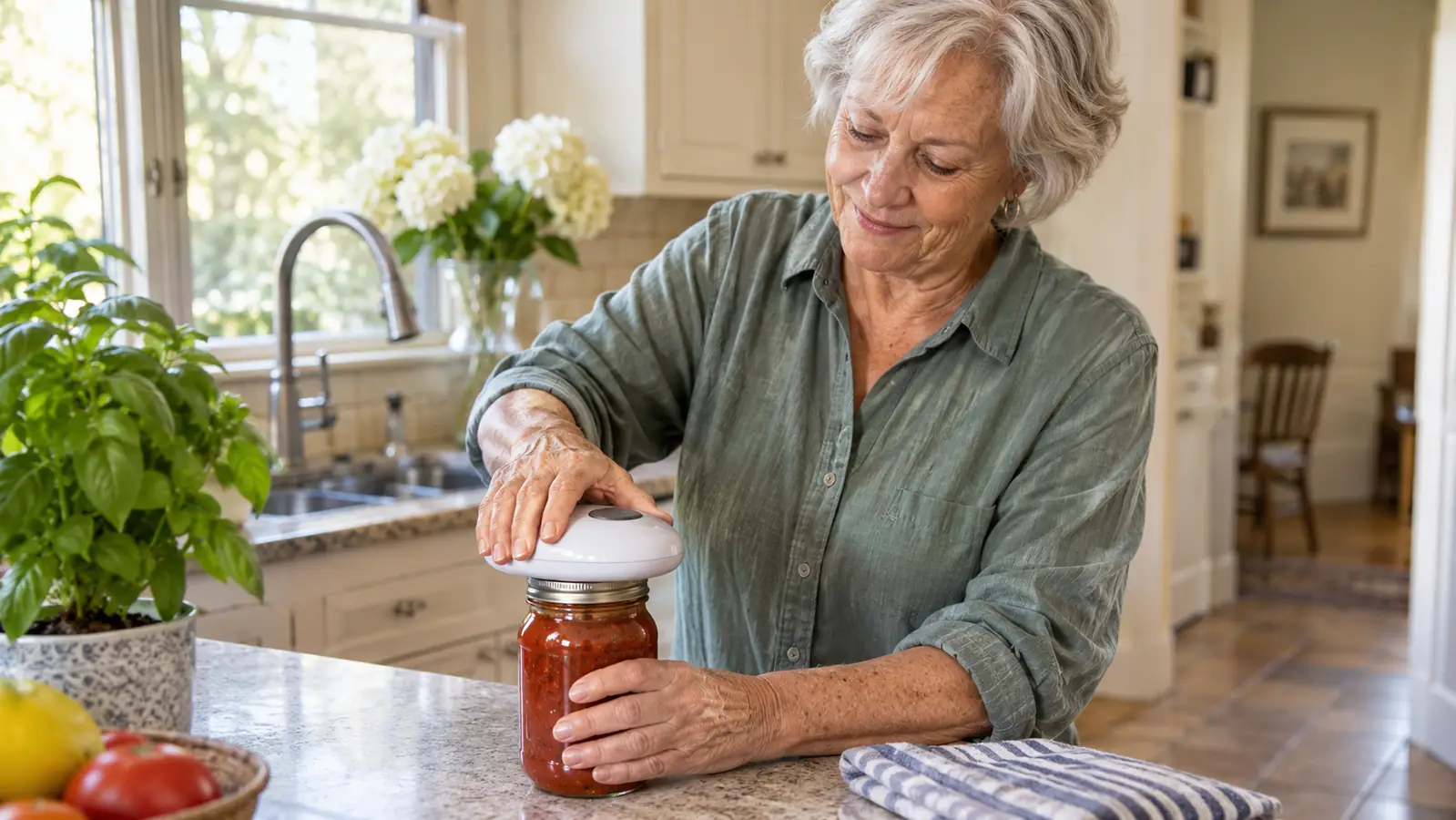
Pickle jars are the honest test. Not the jam, not the salsa. A quart of dill pickles, cold out of the refrigerator, lid on tight enough that it pops when it finally lets go. I need one every Sunday for the potato salad, and about five years ago my thumbs stopped cooperating. Arthritis at the base of both thumbs, my doctor told me, along with the right knee. I have tried the rubber pad. I have tried running the lid under hot water until the glass was too slick to hold. I have tried tapping the lid on the counter, which mostly taught me that glass jars do not care.
What finally worked is a small electric gadget called the KITCHENMUH electric jar opener. I bought mine in May of last year, so I have had about eighteen months with it, and it worked the first day, which surprised me. Eighteen months later it still sits on the counter beside the bread box. What I want to give you here is not a sales pitch, it is the technique, because there is a right way to seat this thing and a wrong way, and the wrong way makes it look broken.
The jar opener that earned a permanent spot on my counter
It grips and turns compatible screw-top lids from 1.2 to 3.5 inches across once you set it flat and press the button. That is the whole job, and it is the only helper my thumbs have gotten in eighteen months.
Amazon Check today's price on Amazon →Step 1: Start with a dry lid and a jar that cannot slide
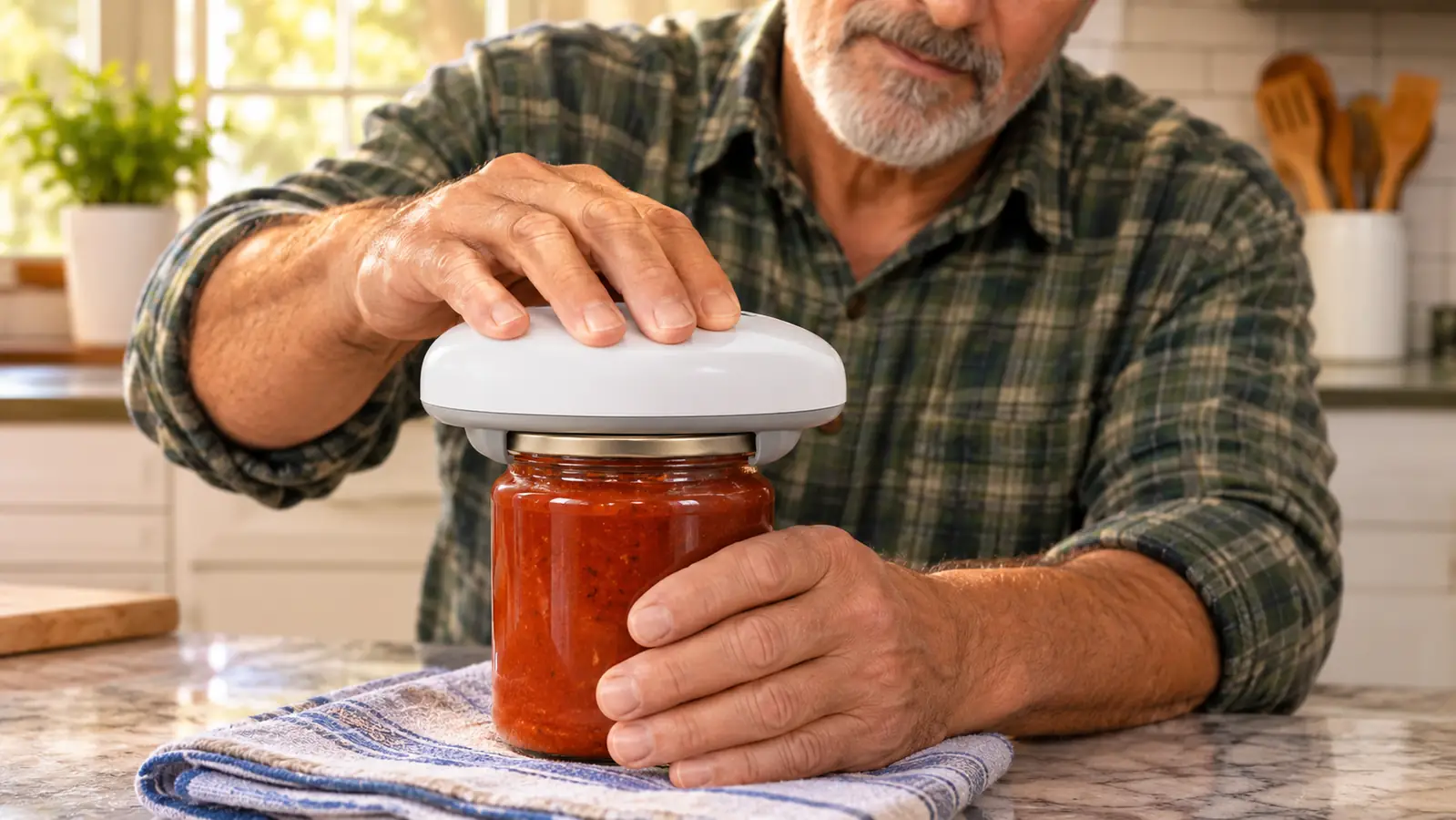
Set the jar on a folded dish towel, not straight on the tile. My kitchen floor is tile and my counter is laminate, and both are slicker than they look. A towel gives the jar something to bite into so it stays put while the opener turns the lid instead of turning the whole jar. I use a plain cotton towel folded twice, and I keep it in the drawer with the silverware so I am not hunting for it with a jar in my hand. Mine is an old white flour-sack square, about sixteen inches across when it is folded, and it lives in the second drawer down. The first week I tried doing it without the towel, straight on the laminate, and I spent more time chasing the jar toward the edge of the counter than I did opening it. A quart jar full of pickles is heavy and it will skate. The towel costs you nothing and it fixes that in one move.
Dry the lid. If you just ran it under hot water, and that old trick still works, dry it thoroughly afterward. A wet lid is a slippery lid, and a slippery lid is exactly the case where the opener has to work harder than it should. Same goes for your hands. If I have been handling chicken or butter, I wash and dry before I touch the opener, because it needs to sit flat and I want it to sit flat.
Then rest one hand lightly on the jar. Lightly is the word. You are not holding it down, you are just letting it know somebody is there. The first month I had this thing I gripped the jar as if it were going to run off the counter, and that defeated the whole purpose. The opener grips and turns the lid. Your job is keeping the jar from spinning, and that takes a fraction of the hand strength it takes to twist a lid.
Step 2: Match the lid to the opener's size range
Lids come in sizes, and the KITCHENMUH opener handles lids from 1.2 to 3.5 inches across. Measure the lid itself, flat across the top, not the body of the jar. Those are two different numbers and the lid is the one that matters.
Most of what I open falls in the middle of that range with no trouble at all. Spaghetti sauce, salsa, jam, the pint of dill pickles when a quart is more than the potato salad needs. The quart pickles fit too. What does not fit is the small end: a bottle of hot sauce with a cap the size of a nickel, or a little jar of capers. It does not open cans either, and it will not touch a bottle cap. I want to be straight with you about that, because I have watched people buy one of these expecting it to handle everything on the counter.
I went through my own cabinet with a ruler before I bought mine, and it took about five minutes on a Tuesday morning. Here is what I found. The spaghetti sauce lid measured a shade under three inches. The salsa was two and a half. The jam was under two. The quart pickle jar sat right at three, which is close enough to the edge of the range that I checked it twice. Every one of those sits comfortably inside the range. The capers, at about an inch and a quarter, are the one thing on my shelf that does not fit, and I still open those with the rubber pad. Pull out the three or four jars you fight with most and put a ruler across the lids. That will tell you more than any review, including this one.
Step 3: Seat the opener flat on the lid, then press the button
Set it down flat on top of the lid. Flat means flat. If it is sitting at an angle, half on the lid and half off the edge, it will not grip, and you will decide the thing is broken when it is only crooked. I set mine down, glance at it from the side to make sure it is level, and then press the button.
Then press and let go. This is the part where old habits are hard to break. My hands want to help. They want to twist. They want to add a little something. Do not add anything. The opener is automatic, it does the gripping and the turning, and the more you interfere the more likely it is to sit crooked and miss.
Two or three seconds is all it takes when you have seated it properly. Last Sunday I timed it, mostly out of curiosity, with the oven timer already running for the cornbread. From the press of the button to the lid coming loose was under four seconds on a quart of pickles that had been in the refrigerator since the week before. My hands, back when they cooperated, took twenty or thirty seconds of grunting on that same jar, and then I would have to sit down at the table for a minute before I did anything else. That minute is the part I do not miss.
Step 4: Give it one more try before you give up on that lid
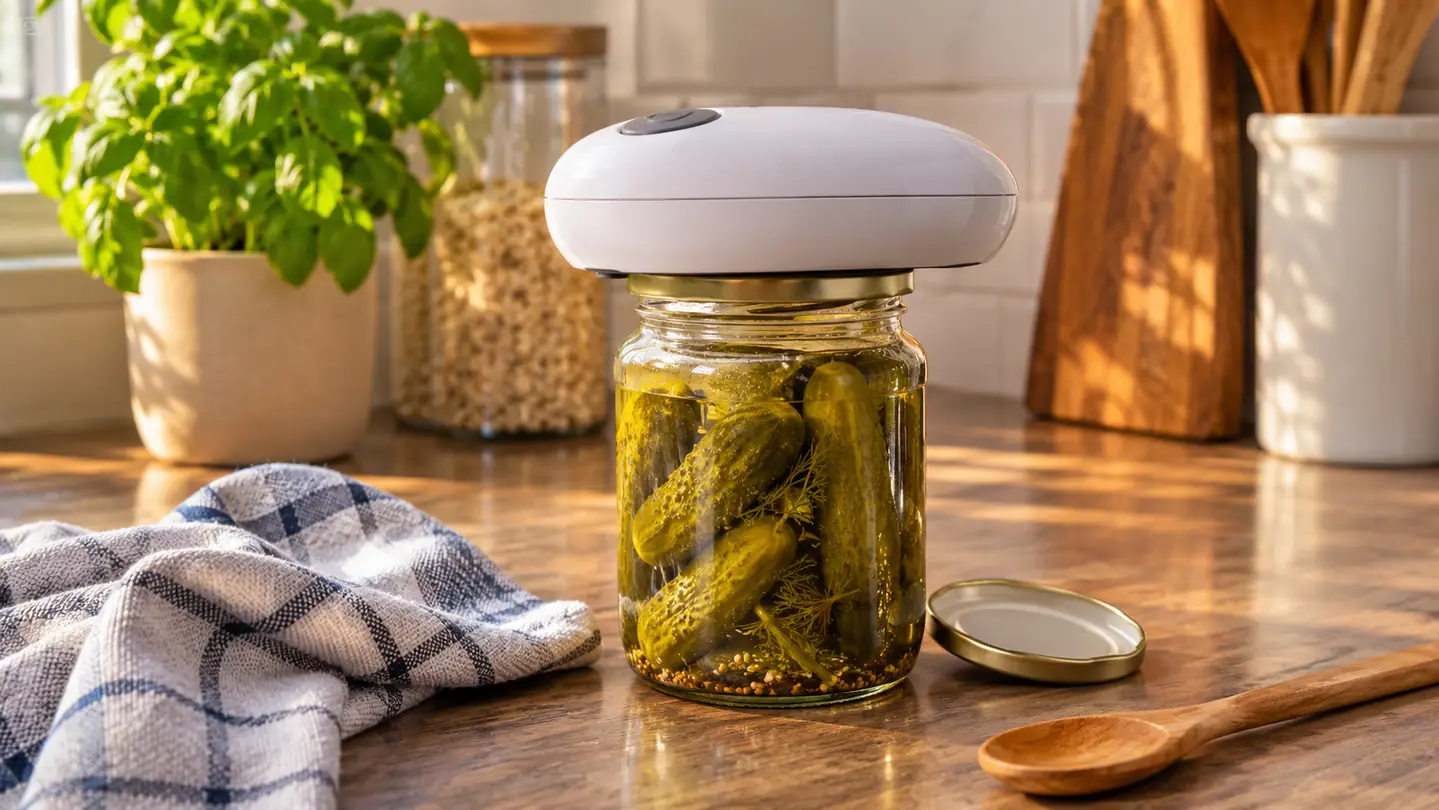
Every so often a lid gives the KITCHENMUH opener trouble. Usually it is a jar that has been sitting in the back of the refrigerator, or a lid with a very smooth edge and nothing for the opener to catch. It sometimes needs a second try on a very tight or very smooth lid, and that is not a sign the thing is dying. Last September I had a jar of bread-and-butter pickles that took three tries. The lid was smooth, no ridges at all, and somebody had put it back once with something sticky around the rim. I dried the lid and the rim, set it down again, and the third press got it. I have not had one take four.
Here is what I do. Lift the opener off, set the jar back down squarely on the towel, dry the lid again, set the opener down again, press. It does not happen often and the second try has worked every time so far.
If the second try does not work, stop. Do not lean on it. Do not press it down harder. Do not jam it sideways to make it catch. Either the lid is outside the size range, or something is wrong with the lid itself. I had one lid last year that was dented badly enough that nothing was going to grip it cleanly, and I took pliers to it, opened the jar, and threw the lid away. That was faster than ten minutes of fighting with sore thumbs, and I say that as somebody who spent twenty-nine years opening gallon jars by hand in a school kitchen.
Step 5: Take the lid off and keep the opener where you will actually use it
Once the lid is loose, lift the opener straight up and take the lid off with your fingers. It will not be tight anymore, but it can still be tacky from whatever was in the jar, so I keep a damp cloth handy and wipe the lid and the rim of the jar before it goes back in the refrigerator. Salsa especially. Then a quick wipe over the outside of the opener with the same cloth. No running it under the faucet, no soaking it in the sink.
Now the part that matters more than it sounds like it does. Put the opener on the counter, out where you can see it. Mine lives beside the bread box and it has not moved in eighteen months. It is roughly seven inches long and four wide, about the size of a thick paperback, and on my counter that is the run of space between the bread box and the coffee maker. I tried the drawer once, the second week I owned it, and by Thursday I had gone back to the rubber pad twice out of nothing but laziness. That told me everything I needed to know about drawers. If you put this away, you will stand there with a jar in one hand, look at the drawer, decide it is too much trouble, and go back to the old way.
Out in the open, the habit builds itself. You stop dreading the pickle jar. You stop putting the salsa back on the shelf because you cannot face it. That is a smaller thing than it sounds, and it is also the entire reason I am still hosting Sunday dinner for my daughter Paula and her husband instead of handing the job over.
What Else Helps
The rubber gripper pad is still in my drawer, and I still use it on the little jar of capers the opener is too big for. Keep yours. Nothing about an electric opener replaces everything else in the kitchen, and I would not pretend otherwise.
A few other things from my own kitchen. Run a genuinely stubborn lid under hot water for thirty seconds, then dry it thoroughly before the opener goes on, because the heat loosens what is under the lid while the dry surface is what lets the opener grip. If you have somebody around, let them break the seal on a brand new jar and handle the rest yourself; Paula opens the new jars when she comes on Sunday and I do the rest of the week. And if your hands are getting weaker generally, not just at the base of the thumbs, tell your doctor. That is not something to work around with a gadget.
For the record on my own situation, so you know who is talking: my doctor diagnosed arthritis at the base of both thumbs about five years ago, the same year she told me about my right knee. A jar opener is a tool that helps me work around it. It does not treat anything and it does not fix anything, and if you are thinking about a new aid or a supplement, check with your own doctor first.
The opener does the gripping and the turning. All I do is set it down flat and press a button, and that is the entire reason it has stayed on my counter for eighteen months.
If your thumbs have been losing the pickle jar argument
I bought mine in May of last year and it has opened every jar I have put under it that fell inside its size range. Set it flat, press the button, let it work. That is the whole technique.
Amazon See the current price on Amazon →