
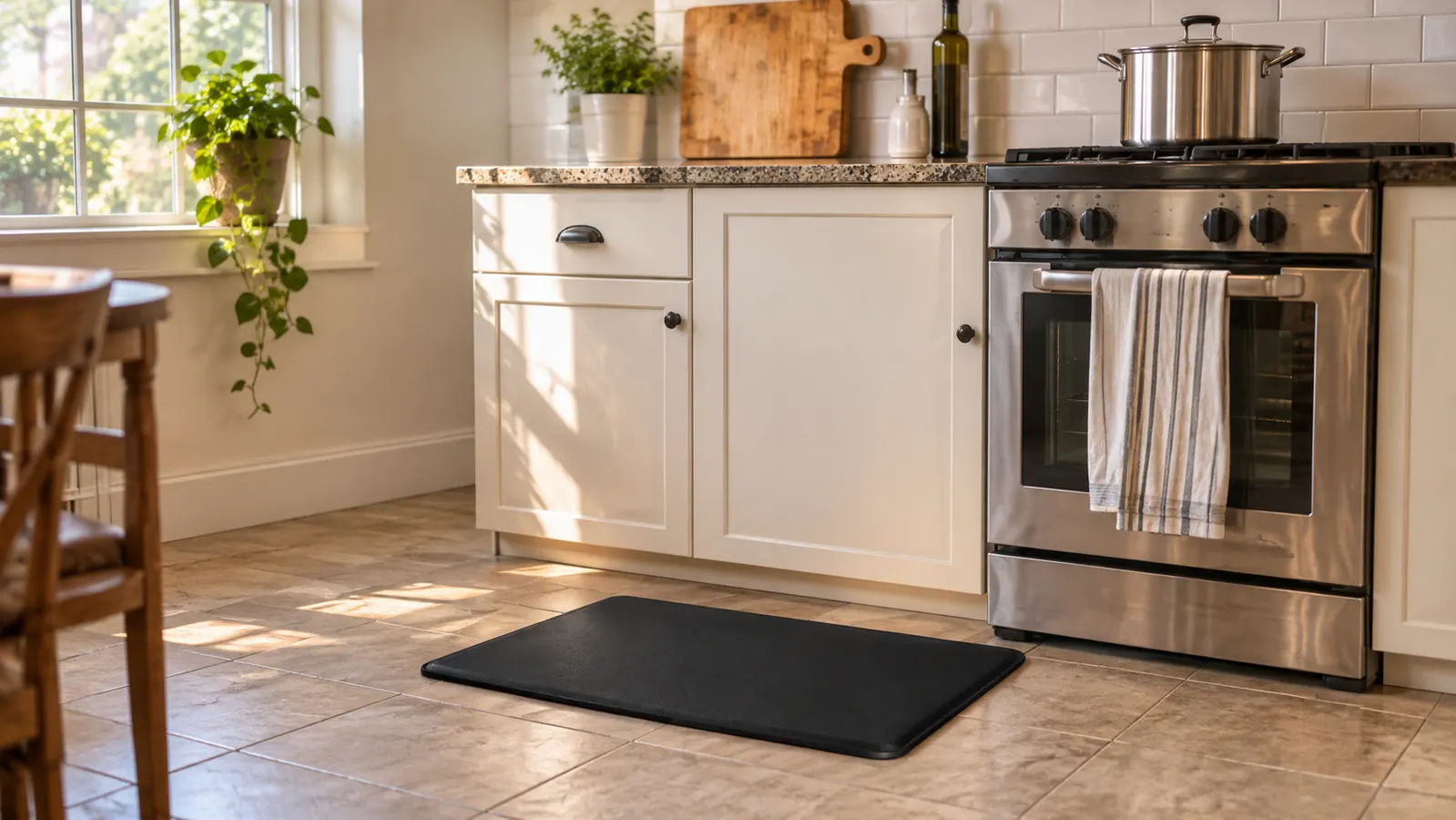
Sunday dinner at my house runs two to three hours, and most of it I spend standing in the same two square feet between the stove and the sink. I did that on bare tile for years. Then my right knee started telling me about it around nine o'clock, after Paula and her husband had gone home and I was wiping down the counters. I am sixty-eight. My doctor diagnosed osteoarthritis in that knee about five years ago, the year I retired from running a school cafeteria. Standing still on a hard floor is one of the small things that got harder, and it is one of the few I could actually do something about.
A cushioned mat is not a medical device and it will not fix a joint. What it does is soften the surface under you, and for me that was enough to make Sunday cooking feel like cooking again instead of a shift to get through. I bought a ComfiLife mat in January of last year, about twenty-two months ago, and it has not moved since. Here is how I would choose one, place it and take care of it if I were starting over, in the order I would do it.
The mat that made Sunday dinner feel like cooking again instead of a shift
Three-quarters of an inch of high-density memory foam, twenty by thirty-two inches, a slip-resistant bottom, and a surface that takes a damp cloth. It was the first thing I bought for my kitchen and it is still the one I would buy.
Amazon Check Today's Price on Amazon →Step 1: Find the spot where you actually stand
Most people drop a mat in the middle of the kitchen, in front of the refrigerator, because that is the open floor. That is not where the standing happens. The place my feet hurt was the narrow strip between the stove and the sink, where I turn back and forth with a pot in one hand and a lid in the other. Before you order anything, mark your spot during a real cooking session. A strip of masking tape on the floor will do it. Mine came out about three feet wide, which surprised me. It felt like I worked in a much bigger kitchen than I do.
You want the mat under the work, not under the walkway. A mat in a traffic lane is something to catch a toe on, and I do not need one more thing to think about while carrying hot food across a room. Mine sits tight against the cabinet, so the front edge of the mat is the front edge of my working space. When I step back to open the oven, I step off it and onto tile. That is fine. The standing is what needs to happen on the mat.
If you cook at more than one station, count them before you buy. Two mats means twice the edges and twice the wiping. I picked the one station that accounts for most of my standing and left the rest of the floor alone. On a long bake day I move a stool to the second station instead.
Step 2: Match the thickness to your floor and to how steady you are
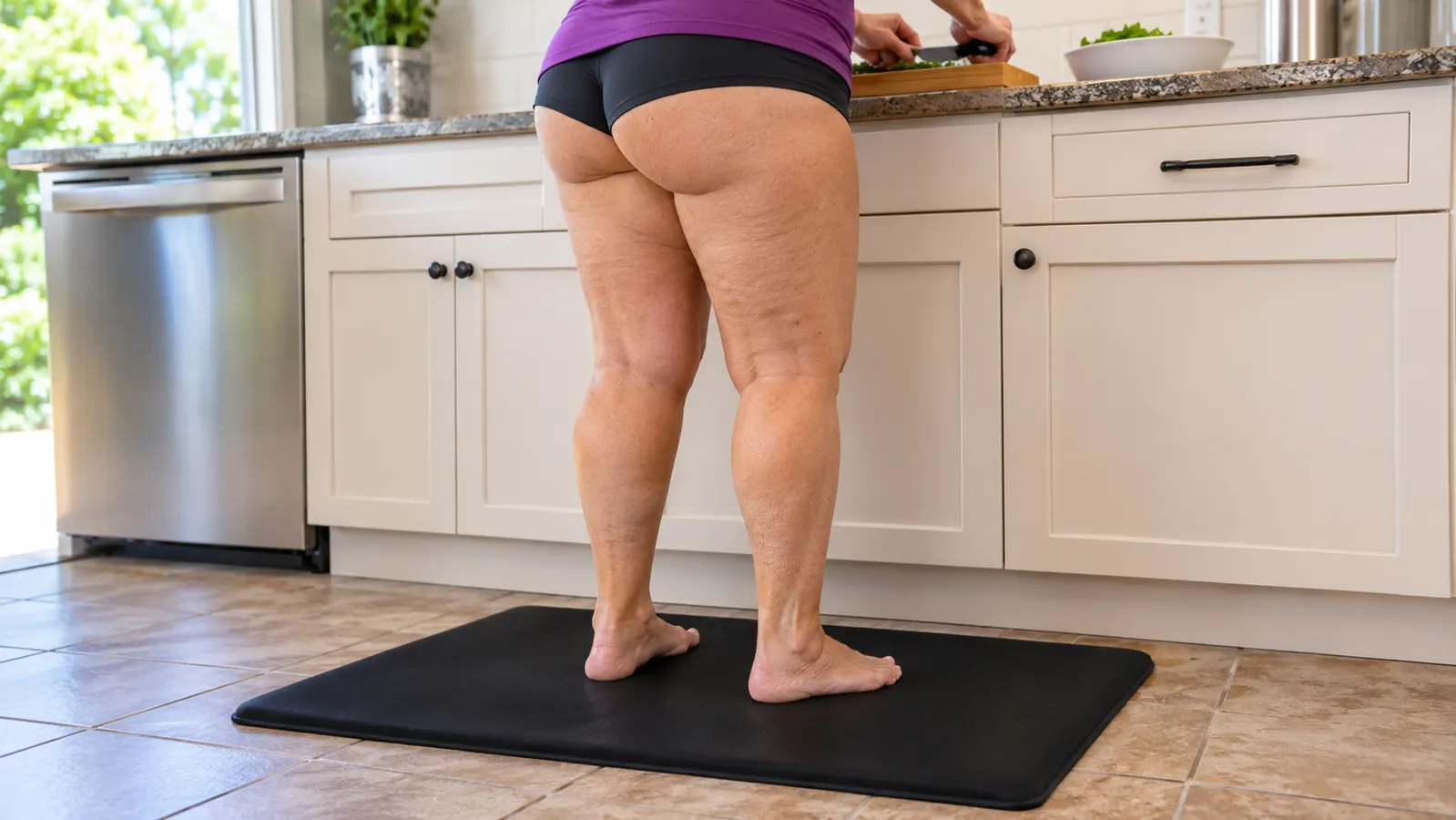
The ComfiLife mat is three-quarters of an inch thick and made of high-density memory foam, not the soft sponge you see on cheaper mats. That distinction matters more than the number on the package. A soft mat feels wonderful for ten minutes and then your heel sinks until you are standing on the floor again through a layer of foam. You want something that gives a little under your weight and then holds you up.
Thickness has a downside, and nobody at the store will mention it. Three-quarters of an inch is a small step up. For me it is nothing, I go on and off it all evening without thinking. If you are unsteady on your feet, or you use a walker or a cane in the kitchen, a thick mat with a soft edge is one more thing to catch. In that case buy thinner, or ask your physical therapist whether a mat belongs in your kitchen at all. I am not qualified to answer that for your body. I can only tell you what worked in mine.
Size matters as much as thickness. Twenty by thirty-two inches lets me stand and take half a step either way without stepping off. A smaller mat means you spend the evening unconsciously keeping inside its edges, and that is its own kind of tiring. If your kitchen is narrow, measure the walkway before you order. Leave at least a foot of clear floor on the side you walk on, and more if you carry things.
Step 3: Set it down once and leave it there
The underside of the mat is textured so it grips, and on my tile it has not slid. Check the floor first, though. Mine gets damp near the sink, and a damp tile under any mat is a slip risk. I wipe the tile, let it dry, then put the mat back. That is the whole installation. No tape, no adhesive, no fuss.
Then look at the edges. A mat that curls at a corner is a trip hazard, plain and simple. Mine has not curled in twenty-two months, which I credit to the density of the foam and to the fact that I never roll it up and shove it in a closet. If yours does curl, do not put a book on it and hope. Turn it the other way for a few days or send it back.
A word on shoes, because this tripped me up. I cook in cotton socks, and socks on foam is different from socks on tile. It is softer, obviously, but it is also a little less grippy. I have not had a problem, and I am careful on the turn where the mat meets bare floor. If you cook in slippers with a smooth sole, try it once before a big meal and see how it feels. Better to find out on a Tuesday than with a pot of gravy in your hands on a Sunday.
After that, leave it alone. My mat does not move. It is not stored, it is not shaken out on the porch, it lives on the floor in front of the counter. Any mat you have to set up before you cook is a mat you will stop using by the second week.

Step 4: Change how you stand, not just what you stand on
The mat is a floor, not a fix. The bigger change in my kitchen was admitting I do not have to stand for the whole two hours. There is a stool at the end of my counter now, and when the potatoes are boiling I sit on it. That was hard at first. I ran a cafeteria for twenty-nine years and standing was just what the work looked like. But four or five minutes on a stool in the middle of a cook does not make the dinner worse. It makes the last hour easier.
Two more things that help me, mat or no mat. I keep one foot up on the open door of the lower cabinet while I chop, which takes some of the weight off my back. And I turn my whole body toward the stove instead of twisting at the waist with a pan in my hand. The big pot of water gets filled with a pitcher at the sink, not carried full across the room. Little habits, but they add up over two hours.
None of this is medical advice. It is what a sixty-eight-year-old woman with one bad knee worked out in her own kitchen. If your doctor or a physical therapist has given you instructions, theirs beat mine every time.
Step 5: Wipe it down and look at it twice a year
The care instructions on my ComfiLife mat say to wipe with a damp cloth, and that is the whole routine. Once a week, and after anything that spatters, I wipe it down and let it dry before I stand on it. I do not put it in a washing machine and I would not. It is foam with a surface on it, and a machine will break the foam down faster than your feet ever will.
Mine is the black one, which was a mistake, because every bit of flour and every crumb shows up like a light. It wipes clean and it is stain resistant, and twenty-two months in it still looks like a mat instead of a rag, but if I were ordering again I would think about that. In a kitchen, that color means you see everything.
Twice a year, press the foam where you stand most. If the middle has gone flat, if the surface has cracked, or if the front edge has started to lift, replace it. A worn mat is not doing the job and it is a trip risk. Mine is still springy under my heel. When it is not, I will buy the same one.
What Else Helps
The mat came first and it helped first, but it was not the only thing I bought. About a month later I got a Bracoo knee wrap, an adjustable one with an open kneecap, and I wear it on my right knee for the long Sunday cook, usually two to four hours. It took about a week of fiddling with the straps before it stopped sliding. It makes that knee feel steadier on the turn between the stove and the sink. It does not take the arthritis away, and the neoprene runs hot in a Florida kitchen.
In March I asked my doctor about a glucosamine supplement and she said yes before I started one. I take Doctor's Best glucosamine chondroitin MSM, four capsules a day with food, two at breakfast and two at supper. I noticed nothing for the first eight weeks. By about three months my mornings felt a little less stiff. I cannot prove the capsules did that, and I say so. Ask your own doctor first, especially if you have a shellfish allergy or take a blood thinner.
The last two are for other jobs. A KITCHENMUH electric jar opener sits on the counter beside the bread box and handles the pickle and spaghetti sauce jars, because my thumbs are the other arthritic part of me. A folding cane rides in the car for the grocery store and the walk around the lake. Neither one has anything to do with standing at a stove. I mention them because standing was not the only thing that got harder, and because fixing one small thing makes it easier to notice the next one.
Three-quarters of an inch of foam between my feet and the tile did not cure anything. It just meant I stopped noticing the floor.
If you take one thing from all of this, take the measuring. Find the two or three square feet where your feet actually hurt, put something cushioned there, and leave it there. That is the whole method. It is simple, it costs less than most of what gets sold to people my age, and it is the reason Sunday dinner at my house still happens the way it always did. I still have arthritis. I still sit down partway through. But I am not standing on bare tile anymore.
Start with the floor. It is the easiest thing in the kitchen to change.
Twenty by thirty-two inches, three-quarters of an inch of high-density memory foam, a slip-resistant bottom, and a damp cloth is all the care it wants. Mine has been on the same tile for twenty-two months and it has not curled or gone flat.
Amazon Check Today's Price on Amazon →